

Intelligent streaming, primed for live
Rilla's intelligent AI-orchestration unlocks real-time Peer-to-Peer video delivery to reduce cost and enhance streaming quality–augmenting your CDN.
Rilla's intelligent AI-orchestration unlocks real-time Peer-to-Peer video delivery to reduce cost and enhance streaming quality–augmenting your CDN.

Deliver flawless live experiences during unpredictable surges while reducing infrastructure costs with Peer-to-Peer delivery that scales with demand.

Reduce rebuffering during the biggest moments by introducing our peer streaming layer to ensure optimal experience for millions of concurrent viewers.

Offload up to 90% of delivery from CDN to peer data layer without QoS regressions while improving scalability and efficiency.
Turn viewers into a peer streaming layer as demand grows - instantly extending delivery capacity when it’s constrained and where you need it.
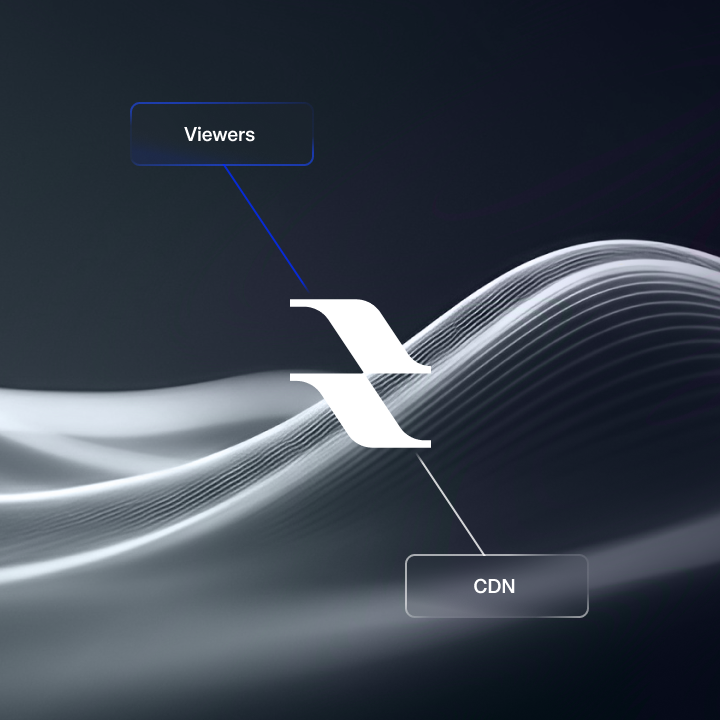
Rilla augments your CDN with AI orchestrated Peer-to-Peer layer that continuously optimizes video delivery, balancing quality of service and cost of delivery for millions of users.

Integrate quickly, analyze your network before live deployment then scale peer delivery safely with sub-second CDN fallback.
We ensure broadcast-grade delivery by being compatible and configurable with your content security and delivery practices - ensuring every stream is protected, predictable, and optimized for millions of viewers.
Optimized for the differences of live, linear, FAST, and VOD (coming soon) whether it’s protecting quality, cutting costs or ensuring reliable delivery at scale.
Rilla acts as a proxy layer in front of traditional CDN. This proxy layer enables Rilla to intelligently manage traffic distribution between P2P connections and traditional CDN delivery. By acting as an intermediary, Rilla can optimise content delivery based on real-time network conditions, user device capabilities, and overall system load. This approach not only enhances efficiency but also provides a seamless fallback mechanism to ensure consistent quality of experience for all users.
Factors such as device capabilities, local network conditions, and geographic location can influence how each user interacts with the P2P network. Rilla's adaptive algorithms work to minimise these differences, ensuring that the majority of users benefit from optimal streaming quality and reduced latency.
Rilla’s performance monitoring system provides comprehensive insights into network dynamics. Each node maintains a real-time connection with the network orchestrator, enabling continuous monitoring of upstream and downstream connections. This includes tracking QoE metrics and connectivity status. The collected data is logged into a real-time monitoring system for immediate analysis and aggregated into traditional metrics systems for historical trend evaluation.
Rilla's volume pricing model is designed to align with the value added to its partners' streaming services. Rather than adhering to a traditional per-GB pricing structure, Rilla’s pricing approach reflects the efficiency gains and network contributions enabled by its P2P technology. This may involve pricing based on factors such as session starts, successful peer pairings, or overall network optimisation achieved. Through collaborative proof-of-concept projects, Rilla aims to demonstrate significant cost savings for clients while establishing a transparent, fair and mutually beneficial pricing framework.
By utilising ML-driven optimisation algorithms, Rilla continuously refines network topology, effectively balancing load and minimising latency across peers. This dynamic adjustment process ensures optimal performance even as network conditions scale or fluctuate, addressing common peering issues that plague traditional CDN solutions.
Rilla's system is designed with robust fallback mechanisms to ensure continuous service delivery. When network conditions or device compatibility issues arise, the system seamlessly transitions to traditional CDN delivery, maintaining optimal QoE. This resilience is a key feature, allowing Rilla to adapt to various scenarios while minimising disruptions to the end-user experience.
Rilla enhances security on multiple fronts. It preserves existing DRM and authentication-based content protection while adding an extra layer of security. The P2P network acts as a buffer against potential DDoS attacks on CDNs, absorbing the majority of traffic. Additionally, Rilla's UDP-based delivery, and proprietary transport encoding make data interception more challenging compared to conventional network requests.